Tuesday, April 25, 2006

Double Bars (windows Curtain

simulator drivers looking for better urban transport


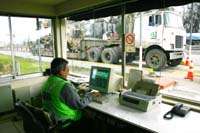
Traffic Act still requires the use of such equipment to get licencia.Cuando operating a vehicle often life gives one chance to fail. However, in a simulator are many opportunities that exist, and which can be exploited to learn. That's why the bus driving simulator, truck, train or subway, which opened yesterday at the University of Santiago (Usach) can cause a major revolution in the future training of professional drivers of such vehicles.


Department of Mechanics and the English company Usach Lander-Simulation and Training Solutions, Inc. developed the software and cockpit for the drivers can train many hours driving before taking the actual vehicle. Undersecretary Transport, Danilo Nunez, said currently the Traffic Act says nothing about an obligation to take a certain number of hours in a driving simulator to qualify for professional driver's license.


"At the moment, the only thing is regulated with regard to different driving courses. To the extent that this type of simulation is taken by the academic world, as in this case, the technology gradually it is adding to the regulations of the country, "he said. The team had a cost of $ 1,500,000 and the Usach charged $ 3 per hour of training, either as truck, bus, train or metro. The addition of over estos equipos a la Usach dependerá fundamentalmente del número de personas y de empresas interesadas en utilizarlo.


El presidente de la Federación Nacional de Buses (Fenabus), Marcos Carter, dijo que durante el gobierno del Presidente Eduardo Frei Ruiz-Tagle ya plantearon la necesidad de tener este simulador. "Viajamos en esa época a Francia a conocer los que utilizaban para la preparación de los chóferes. Este equipo es fundamental en la formación de los verdaderos conductores profesionales". El jefe de Operaciones de Metro, Jaime Adasme, dijo que en las noches preparan a sus conductores y que este año definirán si el tema lo hacen con una universidad o con tecnologías vistas en otros países.


As pilots.

sector Authorities believe that the ideal is that in the future, the Traffic Law requires that each year the driver is examined on this computer. Commercial pilots must be mandatory for flight simulators every 6 months. If you are disapproved, some airlines are fired immediately.

TRAINING


Depending on the demand for transport companies, the Usach see if it incorporates other simulators.


This is a contribution of: RODRIGO CERDA Q. Pablo Ramírez Torrejón

(AC).

Sunday, April 23, 2006

Marble Tile For Sale Online

"Rays of Hope" to transition from a world without oil.


This text was written 30 years ago, as a preface to the book "Rays of Hope" to transition from a world without oil by Denis Hayes.


Just half a generation separates us from the moment that will result in world oil production, after which begin the inevitable decline that remains the main source of commercial energy available to humanity.


When oil production begins to wane, are still in circulation some of the cars sold in those days. The transition to a world of depleted oil reserves is now an imminent reality, and may be painful to not be ready to ella.No it comes to deciding whether or not we will make that change, since it is inevitable. All that should be discussed is whether it will be soft, as a result of careful planning and serious preparation, or simply chaotic, period of constant aggravation of endless political and economic crisis.


Very few world leaders, if any, that have a clear picture of the landscape that will provide their respective countries in a world without oil. Although we would leave the future task of adapting to the new situation, the story will prevent it. She has entrusted to our generation's responsibility to plan and make that transition.


The curve for the existence U.S. oil can be used as a global prototype because it highlights the inevitability of decline. After several decades of growth, oil production in the U.S. reached its peak in 1970, and since then has declined from year to year. It is predicted that by 1990 or shortly afterwards will be a global oil depletion, but with one important difference: while the U.S. was able to use other oil producing countries to balance the deficit, the world will now be able to do so. The awareness that one day could not have oil urgently claimed not long ago, it was believed that nuclear energy would eventually be able to fill any gaps.


However, the nuclear dream is beginning to fade in view of atomic energy in turn generates new economic, political and ecological. This book seeks to address some of the steps inexcusable on energy conservation and improvement of some of the alternative sources.


the energy problem is studied within a global perspective, for example, that the fuelwood crisis in countries developing joins the waste of energy that make the rich countries that have excessive number of cars to match everyone in the world oil market. At this time humanity is facing one of the most decisive showdowns in modern history and is very little time left to prepare. The inevitable transition is primarily technological, but it also promises to completely reshape our economic system and our social structures.


This Denis Hayes analysis suggests that if the world becomes highly dependent on renewable sources of energy will be very different from what we know today. As reinforces the importance of solar energy, both directly and indirectly, increases the certainty that it will affect the population distribution between urban and rural areas, and possibly decide on the final settlements in accordance with planet provides capacity for sustenance. Rays of Hope is an initial effort aimed at exploring how it will be the world after the oil age and how they will travel the way to him. The brunt of this book lies in its perspective, both historically and globally. Denis Hayes is contributing to the personalities that drive public opinion and decision makers at all levels, warn that the energy issue will become energy crisis is not immediately adopted appropriate measures.


This book is part of a broader effort by the Worldwatch Institute to identify the most pressing problems of mankind and lead them to world attention. Of course, the transition to a world devoid of oil has to occupy a central place in the list of puzzles to solve.


This is a contribution of: Lester R. Bronwen, Worldwatch Institute.


Pablo Ramírez Torrejón (PD).